JDaters Anonymous
Group therapy in a blog.
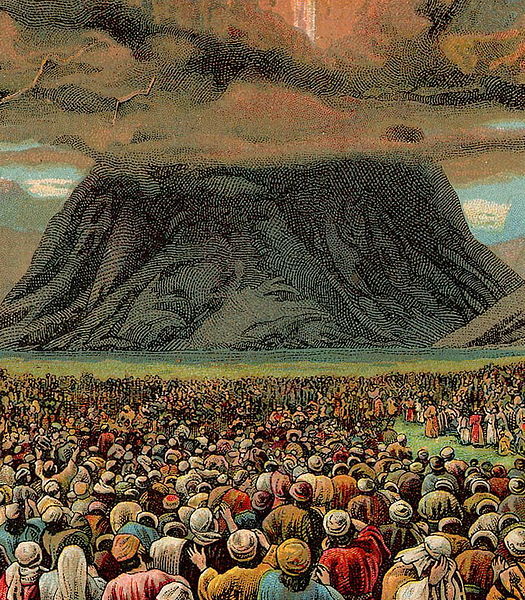
Receiving the Torah at Mt. Sinai (unknown source)
Every year, it happens again. We surround the base of Sinai, to re-receive what has been given and regiven, year-to-year.
In the span of a year, most of us haven’t changed that much. Or at least, that is what we think, when confronting these texts, ideas, people we may not have considered much in the past few months. But the truth is that perspective isn’t often the big bang, a paradigm shift, a tectonic movement of earth under feet, that rattles assumptions and forces a review of priorities. Sometimes it starts with reconsidering a word, or a person, or a word from a person.
A once-and-perhaps-future friend once told me that you can’t change people. Maybe not at their essence; maybe there’s a part of us that exists before we’re aware of existence itself, and this element is immutable, ingrained. But people change every day. They change their minds. They change careers. They look at a person differently, or see a new meaning in a text, or suddenly claim a path as destiny with a passion that no one could have foreseen.
Some people object to the cycle of holidays, to the annual repetition of the same rituals, often with no change perceived from one year to the next. But I try to take the opportunity to move in some way, to extrapolate a theme from the biblical or the talmudic meaning of the day and let it inform my life, words and actions. It’s a difficult exercise, this receiving, this accepting. The practice of it requires exercise – although the prescription is annual, bound to the calendar, repeated exercise even more often would show greater benefits.Â
But there’s a disconnect. If the Jewish people received the Torah at Mount Sinai, and the mountain was their wedding canopy, and God declared love for the Jewish people at that grand elevation of nature, and we entered into partnership, then the reigning metaphor of the receipt of the Torah was the declaration of relationship, a declaration of commitment and covenant, the analog of which I currently lack. But this time on the calendar comes annually, whether I’m single or not, to remind me that relationship is a value, is possible, is important.
So I think about my words, about how the use of them binds me to others in this world and to those who are beyond, how they aid me in connecting to relationships that nourish me, and how they nurture my innermost self and soul. This year, those words are different than they were in tone and register, but still serve to adhere me to history and to humanity.
I hear voices in the texts, sacred and profane, past, present and future. I have hope that they will steer me toward an enhanced ability to recognize and welcome goodness, should I be lucky enough to find it.
We are constantly in the process of receiving, whether it is Torah, or meaning, or love. But it takes an open mind, and the willingness to say, “my perception is not set in stone tablets.” I might fear restrictive laws and tremble at the foot of the mountain, but when it comes to the opportunity to accept relationship, I am certain that I will.
 Greetings, those of you who are still tuned into JDatersAnonymous. I wanted to apologize for my absence these last several months – there are two main reasons that I wanted to share.
The most major reason for my absence was the death of my mother, Shulamit Kustanowitz, mid-May. (Those of you who read my other blog, My Urban Kvetch, undoubtedly already know this, as the last two posts over there were about my mother.)
I’m making my way back to life, through the process of the Jewish year of mourning, and her memory and spirit informs my writing and my progress toward a new normal. But both the writing and the progress are slow. So I beg your patience during this time. And may her memory be for a blessing.
Beyond that very major reason for my disappearance, I’ve frankly become aware that writing for this blog about the challenges of dating (and specifically Jewish dating) in a modern, connected world fills me with despair. And it’s not the process of writing itself – it’s the responses: the despair of others, the negativity, the name-calling, the derision of men from women and women from men, the anti-Semitic slurs against Jewish men and Jewish women, the perpetuating of stereotypes that aren’t fair to anyone.
So I’ve been absent. And may remain so. At least for a while. If I’m motivated to write, I’ll write. But this hiatus is important enough for me to violate my own blogging advice (“blog regularly, so your audience knows they can rely on you!”) in favor of emotional balance.
I would still really like it if – on and off the blog – we could live up to the motto I had in mind when I founded this non-geographic place: “Group therapy in a blog…welcome home, singles.” But home is supportive, where everyone knows and accepts you for who you are. This place has not been that kind of home in some time, but I hope that it will be again one day.
Those of you who have been readers for a while and want to submit guest posts, please feel free to do so: jdatersanonymous at gmail.com. But it is likely that, aside from those posts, this blog will not be updated for a while. Thanks for your readership and your support – I will be back when I can.
Until then, wishing you good health, friendship, love and happiness.
 It’s one of those seasonal romances, the kind in which you’ve totally forgotten that your partner is there, waiting for you, and then you realize all the time you’ve wasted. You rededicate yourself, knowing that if you’d been more attentive all along, the effort now would be less strenuous, and you resolve to never let it happen again. It’s spring, and suddenly you see the optimism of possibility. You spend late hours together, over lunches and dinners, tea, coffee, or sometimes a glass of red wine or a shot glass full of Bailey’s as you drift past midnight and worry that your brain is buzzing too much with stimuli to sleep. Occasionally glancing at the window, you know it’s late enough at night that some people consider it early morning, and you might just see day beginning to break over the trees in the yard.
Sadly, the situation above is not one of romance, but one of tax frustration. The long hours come before and after a long day at one or more jobs, and the exhaustion level is considerable. I’ve been spending a lot of time with my receipts, categorizing and adding them together, trying to figure out how they all fit into the financial picture that is my state and Federal income taxes. This year, I’m consulting an accountant, and hope this will make the process easier at some point – if not during the birth pangs of this startup reorganization of my finances, then hopefully by next spring.
And it occurred to me that perhaps there is a lesson here for some of us, especially those who tend to read into things a lot.
There are things we do because we want to do them so much that they become a life requirement; these things are intrinsic to our self-identity – if we ceased to do them, we would cease to be the selves we have constructed ourselves to be. Other things we do because we have to do them, but if someone – a parent, the government, society – was not forcing us to do so, under penalty of fees, imprisonment or being grounded – we would not do them. The looming threat of jail or going to bed without supper or being shunned by society is what motivates us to do these things. This is why we do an annual tax review or pay our bills even if we think the cable bill or the rent is too damn high.
But then there’s everything in the middle. We might enjoy doing some of those things, but we don’t make them a priority. If we happen upon them – if we see someone post a funny video on Facebook, or if we note that someone is on GChat and has changed his or her message, we might check it out, but if we didn’t, we wouldn’t feel a void because we wouldn’t know what we were missing. If we really see something in that middle zone that catches our attention, we might change its status – realizing it was something important, either because of obligation to a person or relationship, or because it was something that we realized we wanted to do a lot more of.
During the busy day-to-day of any given year, we can forget about the things that we have to do, and only see what we want to see, and do what we want to do. Around tax time, it becomes all about the obligation – to count the literal level of our own worth and submit a report to our supervisors so we can make sure we are pulling our own weight in this crazy world. But there’s a middle ground full of possibilities, some of which can move and inspire us in the months ahead to achieve a more steady, committed pace – we can send some of those minor attachments up to the majors, making them priorities instead of past-times, and maybe break it to some of the devoted, but limited, pursuits that they’re better suited to minor league play.
Perhaps a bit of attention to the middle, on a more consistent level year round, can help strip the literal or figurative Tax Days of their power to terrify; without a threat looming and forcing us into drastic action, we can identify the ideas and pursuits with staying power and invest our energies and resources accordingly, and hope that our investments enrich our lifestyle in inspiring and energizing ways.
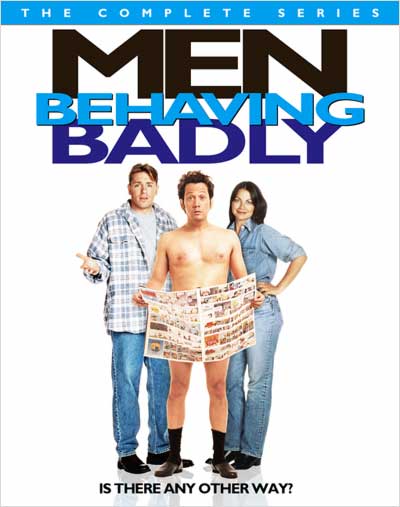
Since my days writing the Jewish Week column, I’ve occasionally acted as a Lorax for Jewish singles: I speak for the women who are also struggling as we encounter men who range from oblivious and inconsiderate to deliberately rude and cruel. I try to balance things – I mean, the Mean Girls of Tina Fey’s film of the same name certainly exist in the dating realm as well – but the reality is there’s a real imbalance when it comes to cruelty. And every time I think I’m done with this post, I encounter another anecdote, another tale of ludicrous human behavior. I try to write with a balanced sense of where the blame lies and attempt to avoid gender stereotyping. But with the title of this post, you get an idea where my head is at.
I’ve of late been privy to some rather disturbing dating anecdotes in which grown men behave like babies, or teenagers, or bullies on the playground exploiting the weaknesses of the women they date/hook up with/rely on. These men bill themselves as single, divorced, separated or even still married. Through deliberate deceptions or lies of omission, they leave the ladies sad, crying, disillusioned, distrusting, damaged and increasingly cynical. Some of these stories were even told to me by the men in question, with a mixture of pride and matter-of-factness. They don’t think that they’ve done anything wrong, or even particularly remarkable, and maybe, if analyzed by dating experts, they haven’t.
All the questions we ask of ourselves and of each other – are there rules and should we play by them, why are men scared of commitment, can Mars and Venus ever have a conversation, why do women ask if their outfits make them look fat, who pays on a first date, why hasn’t he called, etc – don’t produce any real answers to speak of, because every person’s situation is different. But we keep asking our friends because we need reassurance. And the eventual outcome of this constant querying is Cosmopolitans and camaraderie, dining and commiserating with the other amazing people who fill our lives while we’re waiting for “the one, ” or “a one.”
It is rumored that there are good-hearted guys out there, the “nice guys” who “would never treat you like that,” the ones who smile and mean it. But the guys referred to in the title of this post are ruining it – and us – for the men who would make suitable partners. If and when we’re lucky enough to encounter more gentle considerate souls, we may not trust them, because our experience has taught us that to protect our fragile selves, we should trust no one at all.
But I’ve long believed that – as idealistic and perhaps unlikely as it sounds – we can earn each others’ trust as we swim in what is sometimes a murky and somewhat seedy dating pool. But we will all of us – men and women, those who behave well and certainly those who behave less well – need to treat each other more honestly and considerately in the courtship and dating process. Like anything worth doing well, it takes practice and effort. But a perhaps foolishly optimistic voice in me says that it’s possible.
A few weeks ago, my friend Amy Klein published this piece in the New York Times’ Modern Love column, about seeking a blessing to marry from a rabbi in Israel.
I might have stopped being Orthodox, but its indoctrination had left me with the sense that nearly anything — God, spiritualists, healers, psychics and witches — might be equally possible. Thus I found myself in an airless Jerusalem classroom with this old rabbi, who had a white beard so long I couldn’t see his mouth and glasses so thick I couldn’t see his eyes.
“Yes, I want a husband,†I admitted aloud for the first time.
This comes from Likeable Media, a site and company devoted to leveraging “social media and word of mouth marketing to create more transparent, responsive likeable companies, organizations and governments.”
Thoughts from you, dear readers? Is he on base, or way off?
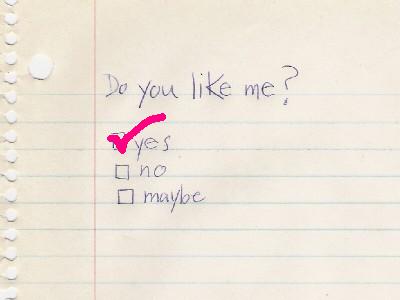
from http://commadotcomma.net
My friend J is funny, smart and sassy, and gets a lot of attention from men. During a recent conversation, I was relating the latest in a string of men whose interest (with a small i) I had mistaken for Interest (the capitalized “Interest” to indicate not just liking someone, but like-liking someone – this is part of the complex language of dating). Then she reminded me of her foolproof way to know if a guy likes her “as more than a friend.”
“You know how to know if a guy likes you? He asks you out.”
This is very simple advice, perhaps brilliantly simple. But I’m not convinced it’s always true. Just like women can be shy around guys they like, couldn’t the same be true for guys? Aren’t there men who need the encouragement in advance, to bolster their confidence that, if they ask, they’re assured a ‘yes’? Or should we assume – a la “He’s Just Not That Into You” – that if he hasn’t asked you out by now, he’s not going to?
I turn this question over to you, the JDA audience, for discussion. Remember: be respectful in the discussion, and generally excellent to one another. Thank you…
 Greetings, JDA readers…
I want to apologize for the lull in posting and for this facelift-in-progress that may have altered the somewhat more classic design that we’ve traditionally had here.
Hopefully, said surgery will be completed soon and the new interface will be more visually appealing and organized than ever before.
Looking forward to additional discussions on dating, relationships and social interactions…happening in this space soon.
Thanks for your patience!
While you might be caught up in cliches or otherwise struggling with online dating, your grandparents are scoring big-time.
Initially considered to be the realm of the desperate and the serial killers, scam artists and losers waiting to meet them, Internet dating is now a mostly socially accepted way of meeting potential partners, especially by 20- and 30-year-olds who grew up with the technology.
Honestly, they had me at “serial killers.” I do have to say that there’s not much of a transition from that rogues’ gallery of what internet dating used to be to it being “socially accepted.” From a research and world trends perspective, I think the jury may still be out. But back to the piece.
But according to experts like online dating coach Laurie Davis, “the over-50 crowd is the largest growing segment” of singles looking for love in cyber space on sites like JDate.com. PlentyofFish.com, Match.com, eHarmony.com and others.
Of course, this is probably known by women who are internet dating in their 30s. (Men in their 30s and 40s are typically chillin’ with the 20-something ladies, whilst the 50-something gents are all up for some hot 30s action.
But here’s a piece of advice for those 50-somethings who may want to jump start a reality television career: Kate Gosselin, of Jon Minus Kate and We’re Not Really Sure What Happened to the Eight, is apparently on internet dating sites like JDate. So that’s Kate Plus (J)Date. (Still no word on “the Eight.”)